

Written by Brendan Sabala.
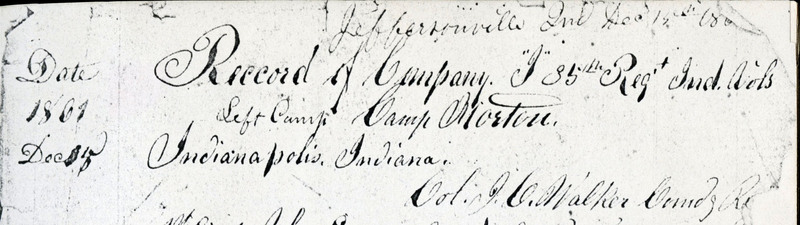
While Idaho is often not considered a harbor for Civil War materials, the University of Idaho Library Special Collections and Archives holds the William Whiteman Diary. William Whiteman was a Sergeant in the 35th Regiment, Company 1 of the United States Army during the Civil War. His diary entries span from December 15th, 1861, to February 19th, 1863, with some additional materials found throughout the book. The diary is not the original, as every entry, letter, or other correlated material was photocopied and printed into a book, preserving the reflections and chronicles of Whiteman’s experiences during the Civil War. Whiteman maintained in-depth entries on occasion, some stretching for entire pages, while others are sparse, with only a few sentences chronicling the day. That is either a reflection of what occurred that day, how much he had to say about what happened, or if he even had enough time to reflect on what occurred. Nevertheless, the Whiteman Diary is a fascinating look into the perspective and lived experience of a white Union soldier in the midst of the Civil War.
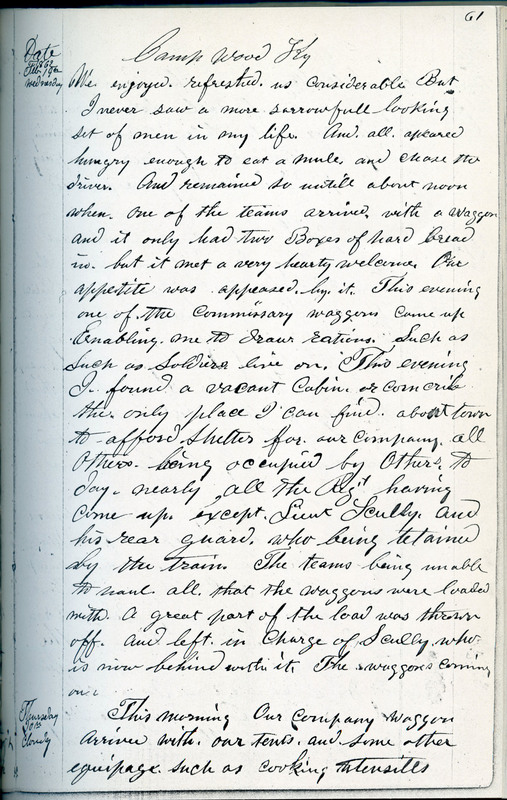
On almost every entry in the diary, Whiteman notes the day’s weather conditions. When the weather is poor, his morale and that of his fellow service members is lower. Rain, for instance, becomes so prevalent that Whiteman’s encampment grows so muddy that it seems his men are part of a cavalry brigade. In addition, Whiteman indicates that hunger is more prevalent during the wet spring and winter months. In one entry, he writes, “I never saw a more sorrowful looking set of men in my life, and all hungry enough to eat a mule and chase the drive” (Whiteman, 61). In another instance, he attempts to bake a cake for his men but feels it would be too dense and might make them sick, unable to fulfill their duties as soldiers. The diary repeatedly mentions the struggle to acquire food and supplies to sustain the soldiers in his company, with some men foraging through farms across the countryside. Whiteman mentioned in an entry that some of the men in the regiment had found some loose hogs running around the countryside, and the men killed the hogs, deeming them a potential danger. Whiteman also notes that the men had no idea who the owners of the hogs were, and still chose to bring the hogs back to the encampment to make use of them. William said, “The company had become quite fond of the fresh pig” (Whiteman, 185).

As the Civil War saw the deaths of thousands of soldiers from sickness, Whiteman’s entries also note the spread of disease throughout his encampment on occasion, primarily during the wetter months of the year. While the terms Whiteman uses lead to some speculation about what the diseases might be, the symptoms were considerable, with many of the men becoming very ill and unable to complete their duties. William himself contracted a disease early in his service. In one of Whiteman’s other entries, he specifically noted that one of the men in the regiment became afflicted with pneumonia and was taken to a hospital. William did not believe he would ever see him again, figuring that the soldier would succumb to the disease.
Methods for coping with the harsh realities caused by the conflict are frequently mentioned, as the diary notes a recurring trend among the soldiers in William’s regiment and company to drink alcohol. A multitude of entries reference Whiteman’s men discovering and procuring whiskey, wines, and other forms of alcohol while marching into towns and farms, and after they had received their allotted pay from the Army. Quite frequently, Whiteman references the various antics the soldiers would get up to while under the influence. Some instances were jovial, while others ended more violently. In one entry, Whiteman discusses that after the men received their pay from the previous day, they decided to acquire an extensive supply of liquor from a neighboring town. They had purchased “a kind of blackberry wine which appeared to have the greatest effect on the men” (Whiteman, 83). Whiteman believed that about two-thirds of the regiment had come under the influence of that wine or some other form of liquor. They were unable to participate in their drills for that day.
The diary also recounts Whiteman’s interactions with Confederate supporters during his regiment’s movements as they traveled into the South. Whiteman takes note of the people in Rogersville, Alabama, and mentions that the people who reside in the town are “the meanest people” he’s ever met and that they are the “bitterest kind of rebels” (Whiteman, 113). Residents of other Confederate supporting towns, while initially fearful of the Union soldiers’ arrival, became more hospitable after witnessing William’s company and how they conducted themselves. Whiteman encountered an older gentleman and asked about the lack of men present in the town. The older gentleman said everyone heard of the “Yankees coming into town” and how they would raze the entire countryside. As his conversation with the older man reached its end, many of the citizens in their houses swung open their windows and doors after realizing their intentions with the town were not nefarious. Whiteman and some of his men were hosted at one of the residents’ homes for dinner. The people had greatly condemned the war and its effects. Then, after some time of chatting, the people had become comfortable enough in their presence to allow them to see their children. The parents said they had nothing to fear, as they were hiding away while they had dinner. This singular entry spanned multiple pages and revealed how fearful these Confederate supporting towns had become of Union soldiers. It is even more interesting to see the relaxation of that same fear the longer Whiteman and his men were present in the towns (Whiteman, 115-126).
A few other entries also mention the servitude of ex-slaves within Whiteman’s regiment. William makes references to these events as Union and Confederate forces began to consolidate in West Tennessee. He also mentions that many African Americans had fled the area, with some staying in their camp and helping the soldiers during their “wash day,” laundry day. William also references that ex-slaves, at least one to two individuals, were helping commanding officers with their duties, primarily with menial tasks like cleaning clothes and cooking. Whiteman seemingly notes the harsh treatment of ex-slaves while working for the officers in the regiment and company. Their “cruel masters” provided ex-slaves better living conditions and expected less work, from Whiteman’s perspective (Whiteman, 90). He also makes mention of someone “stealing one of the officers’ negroes,” an instance of the kidnapping of an ex-slave who worked for an officer in the company (Whiteman, 90-91). Whiteman takes note of the treatment of enslaved peoples and ex-slaves on occasion throughout his entries, with another instance of men from the 21st and 35th regiments who “committed outrage on a female slave for which they ought to be punished for in some manner” (Whiteman, 109). Whiteman’s recollection of events, his perspective, and even the terms he uses, expose how white Union soldiers treated and perceived ex-slaves at the time of the Civil War. William certainly was not hateful in his entries, but he was very much a product of his time.
These are just a few of the themes found within the William Whiteman Diary, with other entries discussing military movements, the practice of religion with the Regiment’s Chaplain, Whiteman’s frequent appreciation of the various places his regiment and company discover in the countryside, the basic duties of a soldier, the struggle for food, and much more. Anyone with an interest in Civil War history may find the Whiteman Diary to be an asset in their research pursuits, whether that be military-focused, black history, social and cultural, or anything else pertaining to the time.
Thank you to Dulce Kersting-Lark and Dr. Matthew Fox-Amato for their assistance in the creation of this post.
The William Whiteman diary is located in the Special Collections and Archives collection Civil War diary, 15 December 1861-18 February 1863. Please contact Special Collections and Archives for access.