

Looking for Downwinder/RECA documentation?
- If you are seeking supplemental proof of residence documentation for Radiation Exposure Compensation Act (RECA or "Downwinder") cases, please fill out this form: Request for Assistance with RECA Claim. You will be asked to provide the name of the person making the RECA claim, the name of the person you are seeking residence information for, the town in Idaho where they resided, the year or date range you require residence documentation for, and how you are planning to file your claim (by mail or online portal).
Since July 2025, the University of Idaho Library’s Special Collections and Archives has seen a notable increase in patrons asking for information from the department’s Idaho Telephone and Business Directories collection. These patrons are “Downwinders,” or people who lived near nuclear test sites in the mid-20th century and subsequently developed cancer.
These inquiries stem from the Radiation Exposure Compensation Act (RECA), first enacted by Congress in 1990 to provide financial compensation to individuals who developed specific cancers and other serious illnesses following exposure to radiation during Cold War-era nuclear testing. RECA was reauthorized and expanded by the One Big Beautiful Bill Act in July 2025. The expanded RECA recognizes that aboveground nuclear weapons testing in Nevada between 1951 and 1962 affected Idahoans as well as residents of Arizona, Nevada, and Utah (covered under the original legislation).
Downwinders who lived in affected areas of Idaho, other western and central states, and US Pacific territories during the nuclear testing period now have a path to restitution, provided that they can demonstrate residence in designated areas during specific time periods. This proof of residence can be hard to come by. Few of us maintain lifelong personal documents with the goal of providing an unbroken record of our residential information.
However, there are sources where Downwinders’ (or their parents’) presence was typically recorded in a standard, consistent way from one year to the next: telephone books and city directories. These annual publications, compiled by telephone companies and directory publishers such as R. L. Polk & Co., regularly recorded the names and addresses of people and businesses. Although telephone books and city directories cannot be said to have comprehensive coverage, these listings nevertheless represent one of few systematic records of residence that remain today.
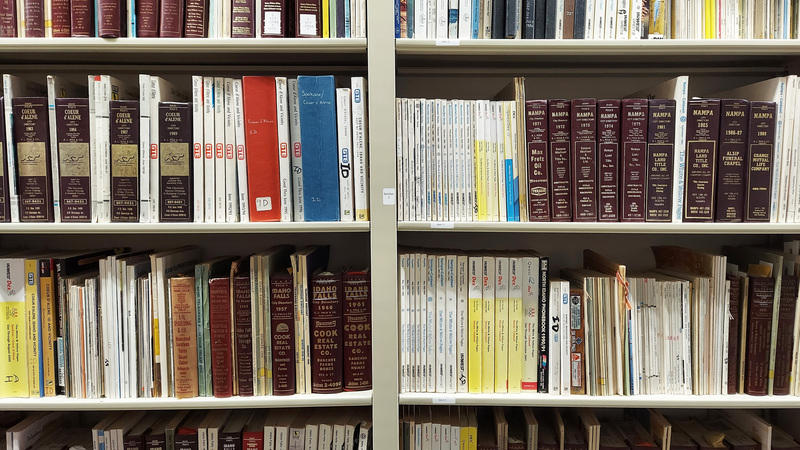
Collections like the University of Idaho Library’s become valuable in addressing this sort of documentary challenge. With nearly 1000 telephone books and roughly 200 city directories covering municipalities and counties around the state of Idaho, our collection is one of the strongest in the state. Researchers may also find similar resources at the Idaho State Archives.
As reference tools, telephone books and city directories pose some challenges. Telephone service was not universal in the mid-20th century, particularly in rural areas. City directories, typically compiled from door-to-door surveys, might have more comprehensive coverage, but they were published less regularly than telephone books and often included minimal information about rural residents. Residents could opt out of inclusion in either listing. Additionally, the U of I Library’s collection has some chronological gaps that can complicate efforts to establish a continuous residence record.
U of I Special Collections staff works closely with patrons to identify relevant listings, following up with documentation of their residence information when it exists. As of late October 2025, Special Collections staff has responded to roughly a dozen of these inquiries, representing greater use of the telephone book and city directory collection in the past three months than the department typically sees in a year.
In addition to highlighting the persistence of Idaho Downwinders in pursuing restitution, these cases also demonstrate the value of archival materials. The U of I Library’s telephone book and city directory collection typically serves genealogical and business record inquiries. Its role in facilitating Downwinders’ compensation claims shows that historical records may have unanticipated and consequential applications. As awareness of expanded RECA eligibility grows, the University of Idaho Library expects continued interest in its collections.