

Within the University of Idaho’s archives are files for more than 4500 students, alumni, and university employees who served in World War II, collected during the war to help the university community keep track of those serving. For each person, the files include at minimum a card listing rank, branch of service, military address, and home address. Most files also include newspaper clippings, correspondence, photographs, notes from university offices, and other items that enrich service members’ stories. These files, assembled by the University of Idaho War Records Committee, form a record of the university community’s contributions to and experiences of the Second World War.
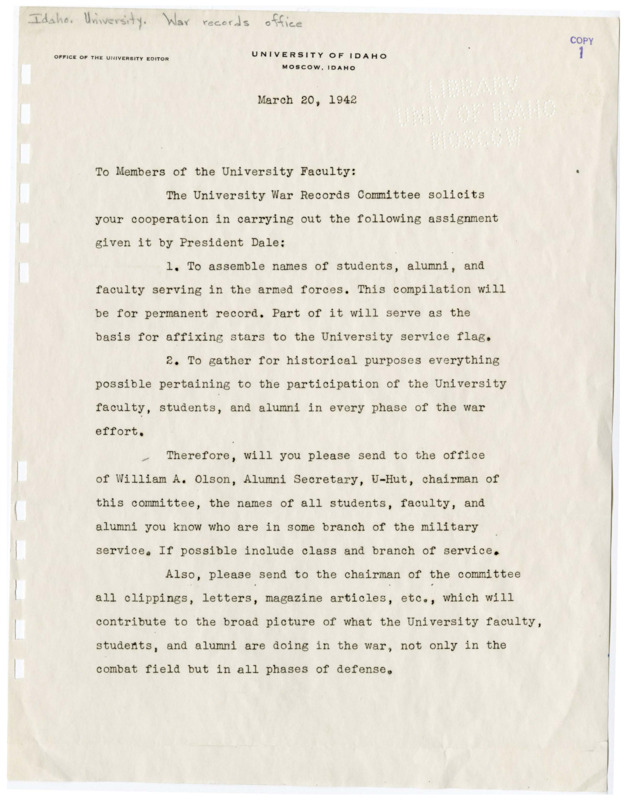
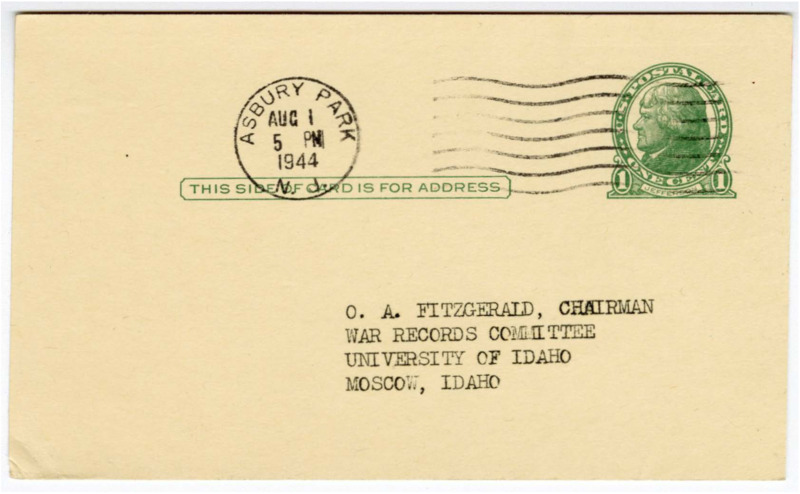
The War Records Committee formed in 1942 under the chairmanship of O. A. Fitzgerald, University Director of Publications, and included university representatives from ROTC, the library, and various colleges. It was one of many similar organizations that formed in cities, counties, and universities across the country, from New York City to the University of Hawaii, to gather and disseminate documentation of local community members’ military service, contributions, and experiences. Before the University of Idaho War Records Committee formed, materials about active service members had accumulated aimlessly in various university offices. The committee set out to gather materials more deliberately, compiling a list of university-affiliated service members and actively soliciting documentation, primarily news clippings and letters, from friends, family, and university employees.
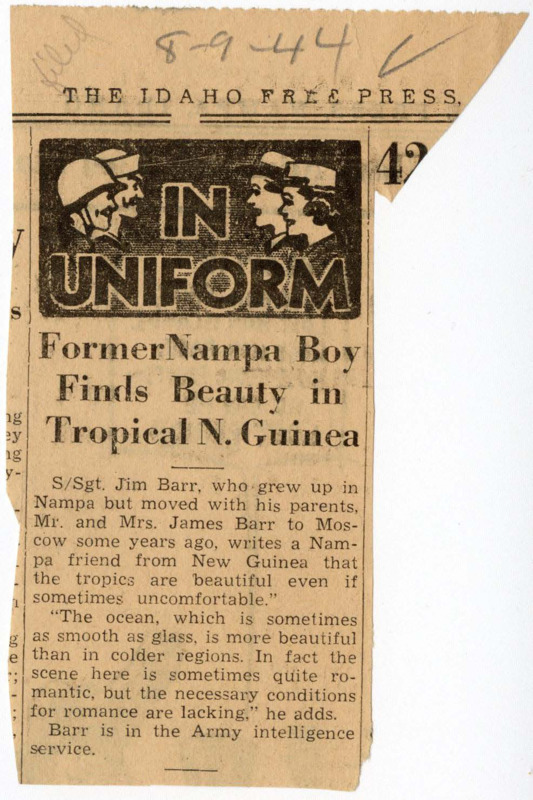
The University of Idaho’s War Records Committee files offer a sense of this community’s experience. A clipping from the Idaho Free Press, “Former Nampa Boy Finds Beauty in Tropical N. Guinea,” captured some of the war’s dislocations. The Air Force Public Relations Office sent a note describing the promotion of one alumnus, stationed in the Philippines, to First Lieutenant. University of Idaho President Harrison Dale included a letter he wrote to comfort the wife of a service member reported missing in action. A Marine contacted the War Records Committee to ask for the address of a fellow University of Idaho alumnus in the Army Air Corps.
The committee also took a more active role in maintaining connections, publishing A Letter from the Idaho Campus, a monthly or bi-monthly “newsy letter” intended to keep service members up to date with news from campus and from fellow University of Idaho students or alumni in the military. Columns covered university sports, faculty activities, and service member achievements and casualties. The final issue, produced in February 1946, included a paragraph for each University of Idaho employee, student, or alumnus killed or missing in action.
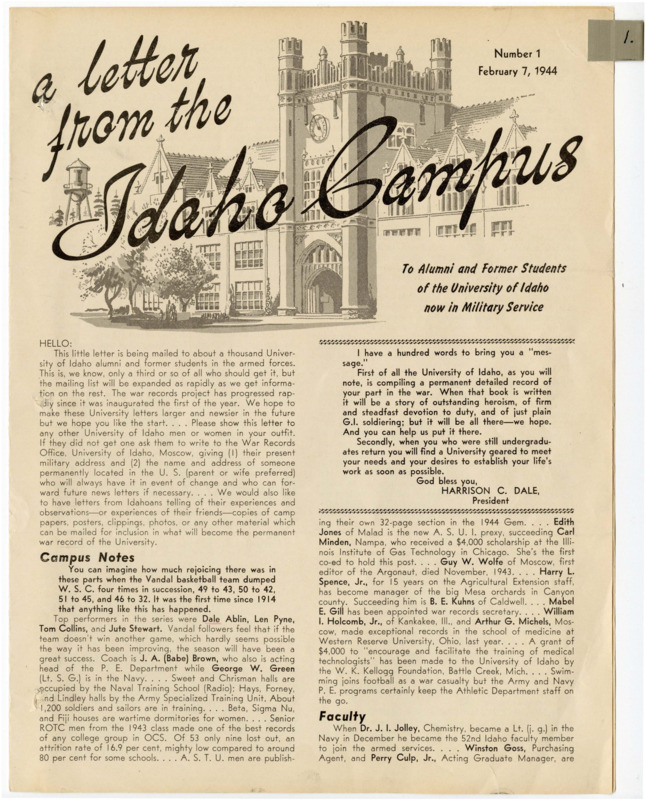
Taken together, the personnel files, newsletters, and other collection items compose a story of a university trying to hold together its community across great distances and extreme circumstances. Certainly, the War Records Committee was aware of the institutional benefits of its work. Internal memos noted that the committee’s work was likely to create “a great amount of good will toward the institution” among service members, parents, and alumni. In the first issue of A Letter from the Idaho Campus, President Dale noted that students in the service would return to “find a University geared to meet your needs and your desires to establish your life’s work as soon as possible.” But while the War Records Committee’s work undoubtedly served institutional interests by directing many postwar students toward the University of Idaho and generating alumni support, it also successfully developed a meaningful corpus of news and connections among those serving, leaving us with a rich historical record of the war centered on the University of Idaho. The collection is open to researchers and veterans’ family members alike through the University of Idaho’s Special Collections and Archives.
(This piece first appeared in the Moscow-Pullman Daily News).