

Post written by Abbie Youngberg, Gary E. and Carolyn J. Strong Special Collections Fellowship
If you are anything like me, then your most direct form of interaction with civic leaders and our governmental system is limited to the few times a year that you enter a voting center with conviction, and you leave with a smile and a sticker proving to the world you have done your civic duty. I want to be embarrassed about this. I want to hide my face in shame for claiming that I am invested in the government and country I live in. However, a few numbers I have recently come across have given me the guilty relief that I am not alone.
In 2021, Boise State University published the Seventh Annual Statewide Survey. Among the many numbers and statistics, we find that 66.5% of Idahoans admitted that they had not contacted a public official in the last year. Further, only 11.2% attended a public protest or demonstration in that time, and about 21% had donated money to a political cause or party.1 It is not completely fair to call Idahoans disengaged or uninterested in their government. But the numbers don’t lie.
As comfortable as I feel falling safely into line with my neighbors in the level of political involvement I participate in, deep down I think I hope for something more. It is one thing to follow your favorite political activist in the news or on social media. It is one thing to diligently vote in each election. It is one thing to be informed about political policies and current events.
However, how much are we missing as citizens when we limit our interactions with government and our leaders? Do you really know your government?
4-H has deep roots in Idaho. The program developed from Boys’ and Girls’ Clubs, programs organized in Idaho schools beginning in 1911–1912. While 4-H is often associated with agriculture, livestock, and county fairs, its educational mission extends far beyond those activities. Idaho 4-H seeks to aid in the development of citizenship, leadership, responsibility, and practical life skills through hands-on learning. Today, 4-H operates in all 44 Idaho counties and three federally recognized tribes.2
The archival record does not point to one individual as the sole founder of the Know Your Government (KYG) branch of 4-H. Instead, KYG appears to have developed out of 4-H’s broader efforts in educating on citizenship. The surviving records of the Idaho 4-H State Office document KYG as early as February 1988, when KYG project manuals were addressing topics like citizenship, state government, courts, politics, and the press.3
Today, KYG is a two-year 4-H project for eighth to tenth grade students. Participants study Idaho state and tribal government, including the legislative, executive, and judicial branches; learn about the role of the news media; and develop leadership, problem-solving, and critical-thinking skills. The curriculum finishes in celebration with an in-person conference in Boise over Presidents’ Day weekend, when the Idaho Legislature is in session.4
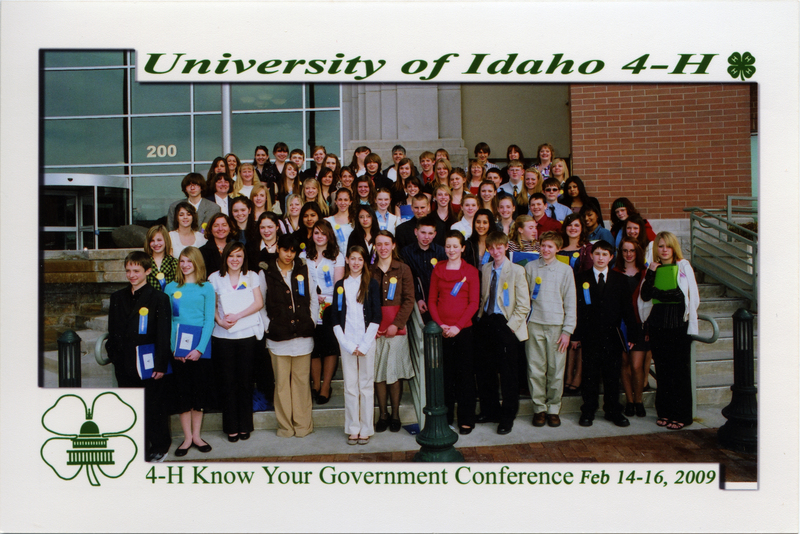
I have had both the privilege and responsibility of processing mountains of these old slides and transcripts, photographs, newspaper clippings, and VHS tapes, all documenting Know Your Government conferences.5 Noting the wild hair and extreme fashions donned by the young people in the images, I realized that 4-H, and more significantly for the topic at hand, the KYG conferences have lived by the tried-and-true philosophy that young people learn best by doing. The activities and experiences I saw in these photos, slides, and videos followed legislative breakfast banquets, mock trials, and legislative hearings, and even shaking hands with the governors of Idaho.6 What became clear as I sorted, organized, and preserved these snapshots of history was that the KYG program established a very distinctive approach: young people were not simply reading about government; they were practicing it.
Amazed by the experiential nature of the KYG program, I decided to dig a little deeper into what was being offered to the youth. These conferences take students directly into the spaces where the Idaho government operates. Students have opportunities to observe the legislative process, learn how cases move through the judicial system, meet legislators and judges, and share their ideas with elected officials.7
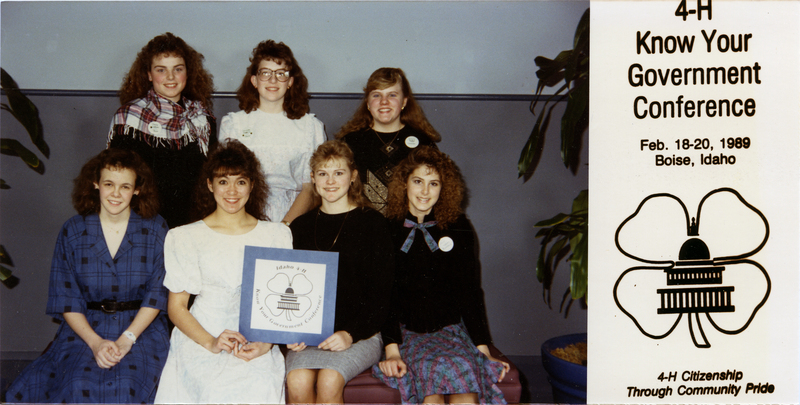
The activities are deliberately hands-on. At the 2024 conference, 158 Idaho youth participated in mock legislative hearings and mock trials. One group debated bills written by their peers while taking on the roles of legislators, witnesses, and lobbyists. Another group participated in mock trials as attorneys, judges, witnesses, and bailiffs, receiving feedback from practicing Idaho judges and attorneys.8 In 2026, KYG activities included the University of Idaho College of Law, the Basque Center, the Boise Centre, the Ada County Courthouse, and the Idaho State Capitol.9
In other words, KYG does more than explain how government works. It asks young people to speak, deliberate, listen, research, write, make decisions, negotiate, and communicate with others. These are skills that can be useful regardless of what political beliefs participants eventually develops.
The young people of today are exposed at an increasingly earlier ages to the political world. With any number of influences on political attitude (i.e. religion, parents’ values, peers, schools, political events, media, etc.), it is little wonder that many young people have “chosen a side” in the political arena, so to speak, before they are even old enough to vote.
KYG, interestingly, does not tell participants what political position to hold, but rather informs them how to participate in public life. Its focus is on understanding institutions, evaluating information, communicating ideas, and experiencing the processes through which decisions are made. The lesson is not that young people must become political activists. Instead, it suggests that engagement and knowledge can reinforce one another. The goal is to open participative opportunities for youth to interact with the governmental institutions around them. These learning experiences then engender a greater knowledge base, one that they can draw on for the rest of their lives. The knowledge they gain makes civic participation in the future feel more accessible.
KYG asks what young people need in order to become effective and active members of their communities. Then it gives them the opportunity to practice those skills, before even being old enough to vote.
KYG’s goal is not to create a particular kind of voter. It is to create young people who understand that they have a place within civic life.
A teenager who spends a weekend arguing a mock bill in the Idaho Capitol may not remember every detail of the legislative process years later. But they may remember what it felt like to stand in a courtroom, speak before a group, question an argument, defend a position, listen to someone who disagreed with them, or realize that government is made up of people who have to communicate and make decisions.
For more than three decades, Idaho 4-H’s Know Your Government program has given young people a structured opportunity to encounter government not as an abstract institution, but as a living system of people, procedures, arguments, responsibilities, and relationships.10 The historical records preserved in the Idaho 4-H State Office collection–photographs, slides, newspaper articles, videos, conference materials, and transcripts–show that this commitment to experiential citizenship has endured across generations.
Perhaps that is ultimately what makes KYG so valuable. 4-H is not only preserving traditions; it is teaching young people which skills are worth carrying forward. Confidence. Leadership. Communication. Critical thinking. Responsibility. Community involvement. The ability to listen, speak, collaborate, and make informed decisions.11
Those skills may look different in a courtroom than they do in a livestock barn, a community service project, a science experiment, or a county fair. But they reflect the same larger idea at the heart of 4-H: young people become capable citizens by being given opportunities to learn, lead, and contribute.
Sources
Knutz, M., Nomee, S., & Scott, D. (2025). Know Your Government project manual (ECS-0026). University of Idaho Extension.
Pew Research Center. (2026, July 16). How Americans Are Engaged With News, Politics, Religion and Civic Life
Pew Research Center. (2026, July 16). Highly Engaged Americans Know More About Politics
Pew Research Center. (2026, July 16). Younger and Older Americans Engage in Public Life in Different Ways
University of Idaho Extension. (n.d.). Civic Engagement and Leadership
University of Idaho Extension. (n.d.). State and National 4-H Events
University of Idaho Library, Special Collections and Archives. (n.d.). 4-H State Office Records
University of Idaho Library, Special Collections and Archives. (n.d.). University of Idaho 4-H collection.
Notes
-
Boise State University, School of Public Service, Idaho Policy Institute, Seventh Annual Statewide Idaho Policy Survey Report (Boise, ID: Boise State University, 2022). ↩
-
University of Idaho Library, Special Collections and Archives, 4-H State Office Records, University of Idaho Extension, “Civic Engagement and Leadership.” ↩
-
University of Idaho Library, Special Collections and Archives, “4-H State Office Records,” M. J. Craig, M. M. Pike, and K. Laughlin, “4-H Know Your Government Project” manual (Idaho Cooperative Extension System, 2004). ↩
-
M. Knutz, S. Nomee, and D. Scott, Know Your Government Project Manual (ECS-0026) (University of Idaho Extension, 2025); University of Idaho Extension, “Know Your Government Conference.” ↩
-
University of Idaho Library, Special Collections and Archives, “4-H State Office Records.” ↩
-
University of Idaho Library, Special Collections and Archives, “4-H State Office Records.” ↩
-
University of Idaho Extension, “Know Your Government Conference.” ↩
-
University of Idaho, “Mock Government Empowers Youth,” University of Idaho News, 2024. ↩
-
University of Idaho Extension, “Know Your Government Conference.” ↩
-
University of Idaho Library, Special Collections and Archives, “4-H State Office Records.” ↩
-
Knutz, Nomee, and Scott, Know Your Government Project Manual. ↩