
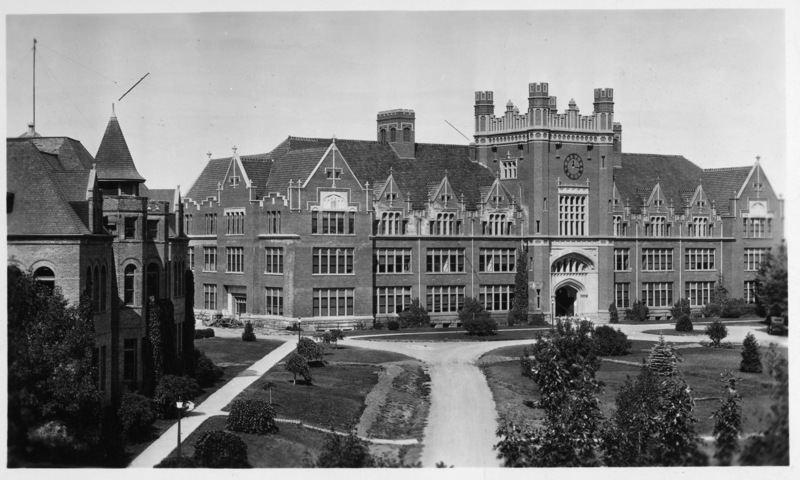
The wind storm that hit the Palouse on December 17, 2025 damaged many things, including homes, vehicles, and countless trees. University of Idaho’s campus was not spared from the wreckage. After more than a week of heavy rains, dozens of trees were uprooted or broken apart by record gusts. Among the flora lost were as many as 15 trees that stood in the Administration lawn’s Presidential Grove. For over 100 years the grove has reflected the importance of higher education both in the state of Idaho and across America, as it offered a visible reminder of occasions when national leaders visited this “beacon for mountain and plain.”
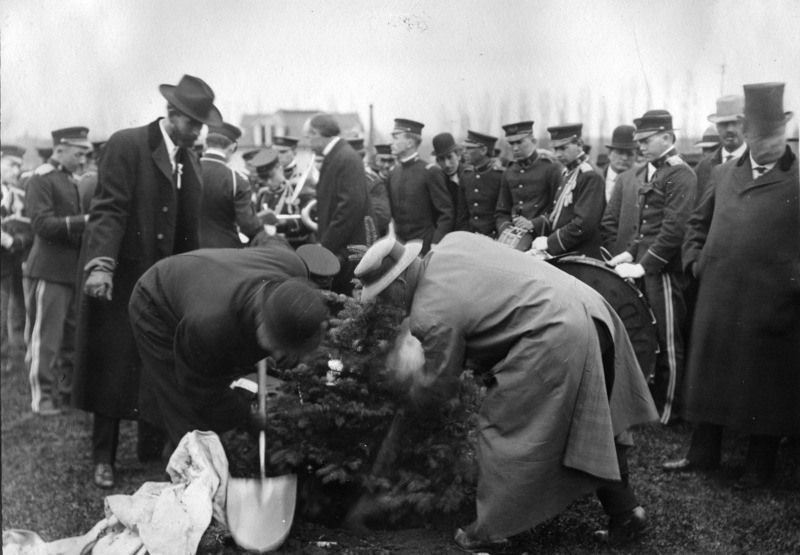
Former President Theodore Roosevelt was the first dignitary to make an improvement to U of I’s treescape. On a damp spring day in April 1911, the beloved 26th American executive arrived on campus to a cheering crowd of several thousand area residents. Some reports claimed 8,000 locals in attendance, while others offered a total of closer to 20,000. Even the lower sum is remarkable when one considers that Moscow’s total population in 1910 did not exceed 4,000. Before Roosevelt stood upon a stage made of wheat sacks in front of the Administration Building, he took a few minutes to ceremonially plant a blue spruce. His contribution to the vegetation of campus was notable because of his political stature, but the addition of another tree on the relatively barren academic green was significant as well.
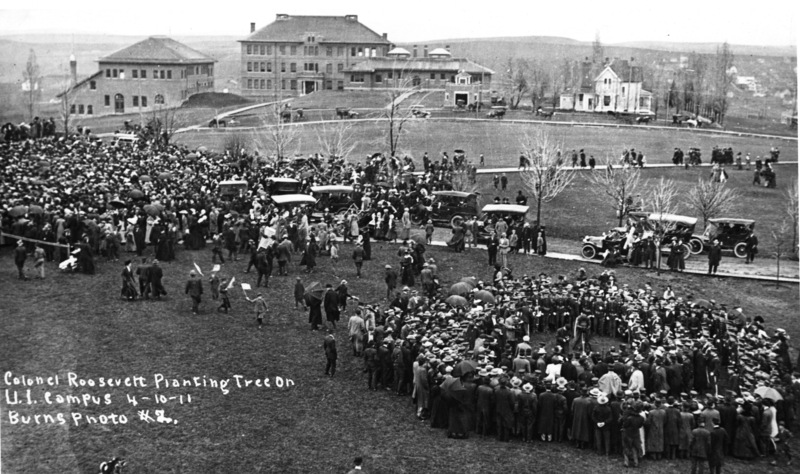
U of I alumnus, attorney, and Congressman Abe Goff was in attendance as a child at Roosevelt’s tree planting. In an oral history interview with the Latah County Historical Society back in 1974, Goff recounted attending as a boy and riding a special train with his parents to the event. His reflections are available online and at six minutes, he discusses Roosevelt’s visit.
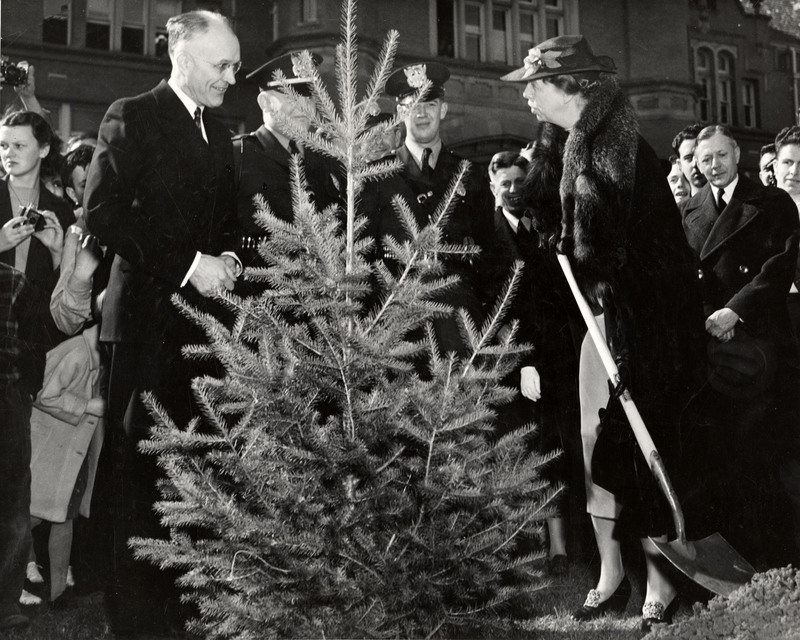
A single tree cannot make a grove, but thankfully just six months later sitting President William Howard Taft visited U of I and added a second planting, this time a Port Orford cedar. The tree long outlasted the remarks that Taft made regarding foreign relations that October. Vice Presidents further added volume to the Presidential Grove. Thomas R. Marshall, Woodrow Wilson’s VP, and Charles Curtis, Herbert Hoover’s VP, planted an Indiana red oak and Engelmann spruce, respectively. It was especially noteworthy when First Lady Eleanor Roosevelt added a Douglas fir to the grove. She had been invited to campus by the Borah Foundation to speak about world peace in 1938, no doubt a reflection of growing unease with conditions in Europe. As reported in the student newspaper The Argonaut, Mrs. Roosevelt called on her fellow citizens to consider the price of peace. “We can have peace, but we must be willing to pay for it. We pay and pay for war. Why shouldn’t we be willing to do so for peace.”
In the 1980s Idaho historian Keith Petersen explained in his book This Crested Hill, “although it is still called the Presidential Grove, other people have also planted trees here. There is a fir commemorating the bicentennial of George Washington’s birth, a pine marking the fiftieth anniversary of the university’s Borah Foundation, and trees planted” for Idaho elected officials and diplomats. The Presidential Grove is often included in campus tours, remembered by alumni, and most recently was described as a contributing feature in the university’s nomination to the National Register of Historic Places.
Clean up of the damage on campus is still in its early days. There is hope that seedlings from the original plantings, cared for in U of I’s state-of-the-art nurseries, will be available to propagate a new generation of trees for the Administration Lawn. Given the university’s tradition of meaningful landscaping, and its expertise in forestry, odds are good that there are still more chapters to write in the history of Presidential Grove.
(This piece first appeared in the Moscow-Pullman Daily News.)
Resources
Latah County Oral History Collection