
Post written by Kacie Kay, Special Collections Intern
In the early 20th century, the United States was in a period of change. Industry was booming, allowing robber barons to continue to thrive into the 1900s while laborers struggled. Wages and conditions, particularly in blue-collar jobs, were horrible to say the least. Groups had been formed among laborers for the protection and defense of workers. The people in power over these laborers were worried by the formation of these unions, fearing the effects on their revenue if strikes were organized and wages were forced to increase. Along with growing unions in the United States, international politics could not be ignored either. Immigrants coming to America for work were seen as competition in the wage laborer jobs they managed to find and occasionally faced blame for their believed political or religious connections, mainly socialism. In the late 19th century to early 20th century, the fear was that socialist-driven unions would bring communism into the government and would destroy the United States’ capitalist society.
These beliefs spread across the country to the Silver Valley in Idaho. The mining boom that had taken over this region made Coeur d’Alene Mining District the primary industry of the region along with railroads and logging. Its presence in the region made the Coeur d’Alene district a center for labor activism of the time. Mine workers within the district started independent unions, like the Miners Union of the Coeur d’Alenes in 1891, and later the larger Western Federation of Miners formed in Butte, Montana in 1893. These workers’ unions were countered by the formation of the Mine Owners Associations in 1891 a month after the Miners Union of the Coeur d’Alenes.
When the wages were lowered, miners would strike, then the association would hire what are known as “scab” workers from out of state or immigrants. This cycle caused protests, some turning violent, and seemed never ending to the miners fighting for better conditions against companies protecting their profit margins. In the Coeur d’Alene Mine Owners Association Papers at the University of Idaho Special Collections and Archives, the signs of this tension are seen through the logbooks kept by the managers of the various mines in the district. Their prejudiced fears of immigrants and of fugitives (perceived as societal radicals) were evident; their wariness of spreading unionism led them to keep a tally of the workers’ nationalities and a close eye on felons from other states whom they were employing.
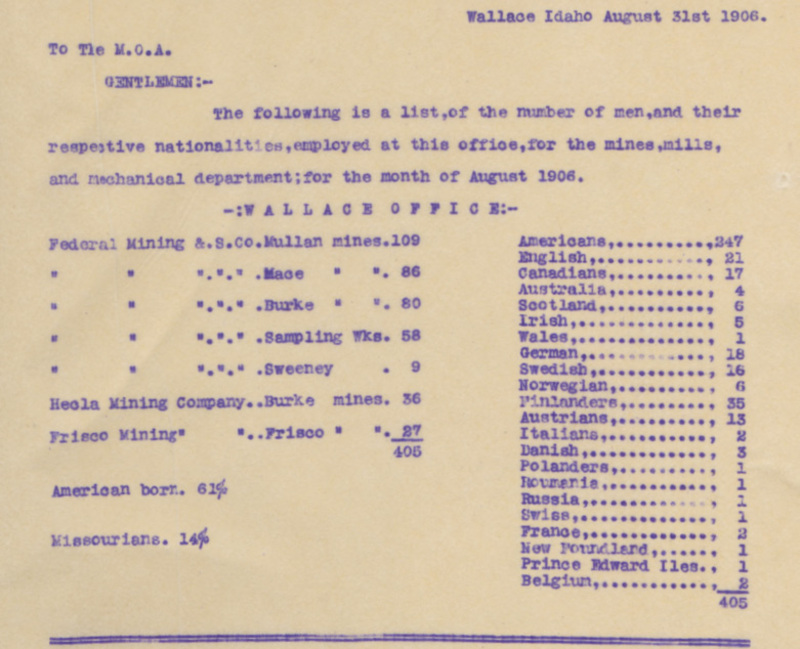
In this scan from the Coeur d’Alene Mine Owners Association papers, workers’ nationalities from the month of August in 1906 are tallied, with Americans holding the majority: 247 out of 405 workers. The mines that were all tallied together are to the left, with the Mullan Mine employing the most with 109 men, both Americans and immigrants. The second highest tally from this month is Finnish immigrants with 35 men. In 1906, Finland had many progressive policy changes, such as being the first country to grant full women’s suffrage rights, but many of them were championed by the socialist party of Finland. Correlations like these paired socialism with women’s rights and the rights of workers, creating a false impression to capitalistic countries that those rights were socialist in nature.
Mine owners and anti-unionists would generalize entire immigrant populations by the politics or culture of their home country. With unions being feared for “socialist” connections, having Finnish immigrants and others from socialist countries was a worry to the industry leaders who wanted to prevent strikes and unionization. While this one report to the Mine Owners Association (abbreviated in the top left as M.O.A.) is not completely indicative of the immigration trends happening across the entire country, it is still a great example of the way that immigrants were viewed as suspicious in the labor industries such as mining.
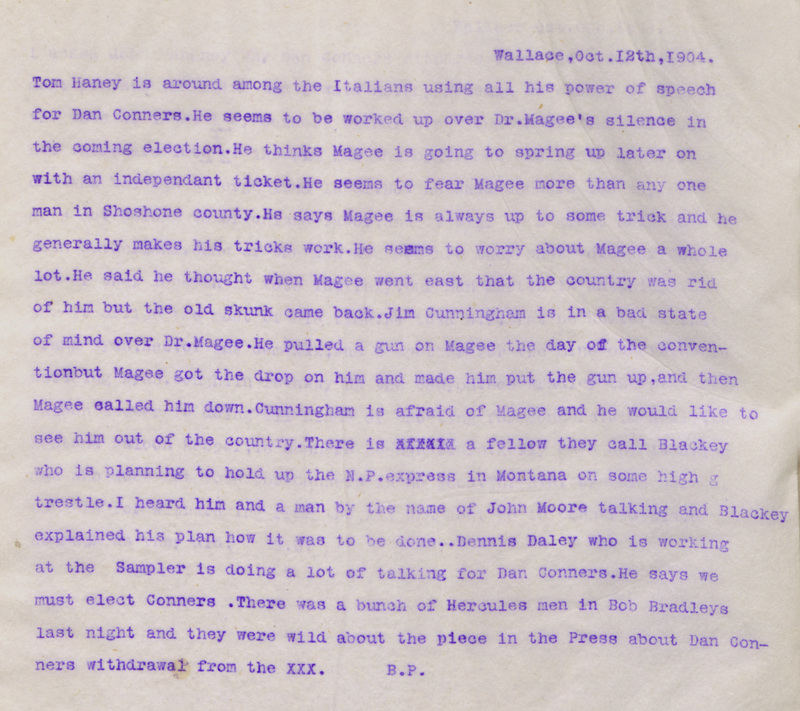
Aside from just keeping track of the nationalities of laborers, the Coeur d’Alene Mine Owners Association also had operatives who would effectively spy on their fellow workers or townspeople and report back on if any talk of unionizing or strikes were being mentioned. There were two prominent detective agencies present in the Silver Valley: the Pinkertons and Thiels. These agencies would place men in mining towns where they would eavesdrop and sometimes even pretend to join in on conversations between miners. These operatives would then report back to the association on what they were hearing and if any talks of strikes or unions were spreading around the workers. The association wanted to make sure they could take care of the issues. That is, removing the “difficult” people before it became a problem for them. While the intent was clear, often miners were able to tell who a detective was, but they played a role in providing evidence on who were already union members so that mining companies could deny their employment. No unions, no strikes, bigger profits… or that is at least what the Mine Owners Association believed.
Outside of the Coeur d’Alene mining district, the contrasts between American laborers and immigrants in blue-collar industries continued with rising political tensions in the country. American labor unions did not rely on socialism in the ways that they were often portrayed to. Many unions in fact, such as the American Federation of Labor that was an umbrella organization for many unions, were anti-Marxist and anti-communist. Some went even further and not allowing other nationalities, races, or women into their unions either. However, the Western Federation of Miners had shifted its beliefs with the increase of socialist members and leadership. The secretary-treasurer and Industrial Workers of the World supporter, William Dudley Haywood, started his union career in Silver City, Idaho, while working as a miner; this is where he joined the WFM in 1896. While he fought greatly for union rights around the country, he was a member of the Socialist and Communist parties.
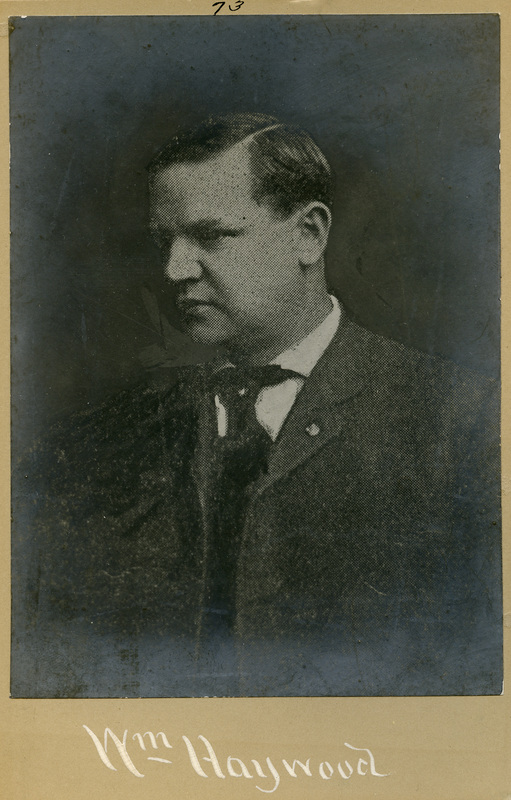
In 1905, Governor Frank Steunenberg of Idaho was killed. A member of the WFM was the suspect, but he claimed it was Haywood and other WFM leaders that ordered it. This changed the subject immediately to the murderous intent of power-hungry unions. It fit the story that labor industries had wanted from the start. Haywood and the other leaders accused of the assassination were ultimately acquitted at the murder trial though. Afterwards, “Big Bill” Haywood became increasingly radical in his political speeches until the WFM separated him from involvement, and he dedicated his time to the Industrial Workers of the World union instead. His political involvements complicated his union efforts though, as he was imprisoned with other IWW members during the first Red Scare for suspected communist espionage in 1918. While waiting for an appeal in 1921, Haywood jumped his bail and fled to the Soviet Union where he spent the rest of his life. This act separated him from the unions he had supported; the IWW even disowning him in a New York Times article published in 1921 for running away. In the Coeur d’Alene Mine Owners Association Papers, a picture of Haywood is kept with other union members and felons so that they could be easily identified if they came to the area. While he did not play a direct role in this collection, the Western Federation of Miners that Haywood worked for was the largest in the region and a concern to the Mine Owners Association.
It is men like Haywood who formed the way that unions were viewed through an anti-capitalist and pro-socialist lens, what the government and industry owners feared. His actions and themes of violent protests for the sake of unions mischaracterized many of the true intentions of unions. The goal was always, or supposed to always be, better conditions, fair wages, and creating better livelihoods for workers in their industries. A great example in media that tells a similar story of the crossroads between unionization, immigrants, and racial divides is the film Matewan by John Sayles. While it takes place in 1920s West Virginia, the film showcases the same themes in mining history that are in the Coeur d’Alene Mine Owners Association Papers at the University of Idaho. It focuses on the struggle for collective organization, violence from anti-union efforts, and the power that mining companies held over their workers. Both this film and the Coeur d’Alene Mine Owners Association Papers show that labor movements have been a long and difficult process in American history, shaping the rise of unions and laying down the path for better working conditions, and that it is the work and dedication of people that can create change. All the materials added to this article are from the Coeur d’Alene Mine Owners Association Papers collection and are available to view at the University of Idaho Special Collections and Archives. Special thank you to Dr Katherine Aiken for her guidance on this post.
Sources:
Coeur d’Alene Mine Owners Association Papers, MG 682. University of Idaho Library Special Collections and Archives, Moscow, ID.
“Haywood in Russia as Sentence Begins.” New York Times, Apr 22, 1921, p.16.
“Haywood, William ‘Big Bill’ Dudley.” VCU Libraries Social Welfare History Project, Virginia Commonwealth University.
“Labor Movement.” History, A&E Television Networks, May 28, 2025.
Matewan. Directed by John Sayles, 1987.
Sheldon, Richard. “Silver Valley Mining Wars: Part 1.” Coeur d’Alene Press, Sept 29, 2023.
For Further Research:
Stanly Easton Papers, MG005. University of Idaho Library Special Collections and Archives, Moscow, ID.
Katherine Aiken Collection on Idaho Mining Companies, MG 480. University of Idaho Library Special Collections and Archives, Moscow, ID.
“Defending Labor’s Rights: Working-Class Politics, 1850-1924.” The Samuel Gompers Papers Project, University of Maryland.
Moran, Patrick. “The Real History of Unions: Violent Communist Agitation.” Americans for Fair Treatment, March 28, 2022.
Sennholz, Hans F. “Socialists Argue about Labor Unions.” Foundation of Economic Education, May 1, 1984.