
Post written by Kate Morrison, Special Collections student staff member
Japan 1949
Four years after the devasting events of War World II, Japan was now under the occupation of the Allied Powers. During this time, Japan was steadily trying to recover from the effects of war. Cities were being rebuilt, institutions were reestablished, and families navigated low resources and displacement.
Under the occupation of the Allied Powers, with General Douglas MacArthur serving as Supreme Commander, the United States established programs such as the Natural Resources Section (NRS) to monitor and maintain resources of economic value in the country. Part of this program was the hiring of field specialists to assist in control and protection of natural resources in Japan. One such specialist was Robert L. Furniss (1908-1981). Robert was appointed by the NRS as a “Visting Expert Consultant” to assist in the investigation of extensive mortality of pine tree species due to bark beetle damage on the island of Honshu, Japan.
At the time, Robert was a forest entomologist stationed at the Forest Insect Laboratory in Portland, OR and had extensive knowledge of bark beetle infestations and forest protection procedures. Furniss would be assigned on two appointments to Japan; November 1949 to January 1950 and November 1950 to January 1951.
Robert’s brother, Malcolm M. Furniss, was also a forest entomologist who served as a visiting research professor of entomology at the University of Idaho. Malcolm wrote of Robert’s service and experience in Japan (Furniss, 2006). While his work in Japan was both impressive and had long lasting effects on Japanese pest control policies, his experience with the people of Japan was equally valuable and interesting.
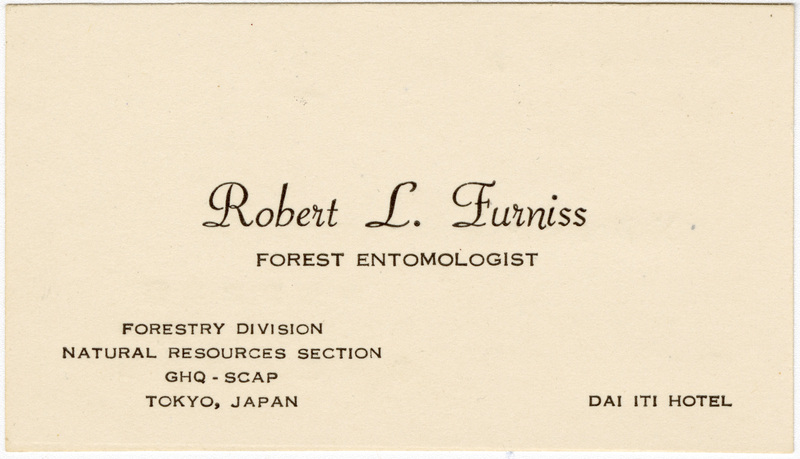
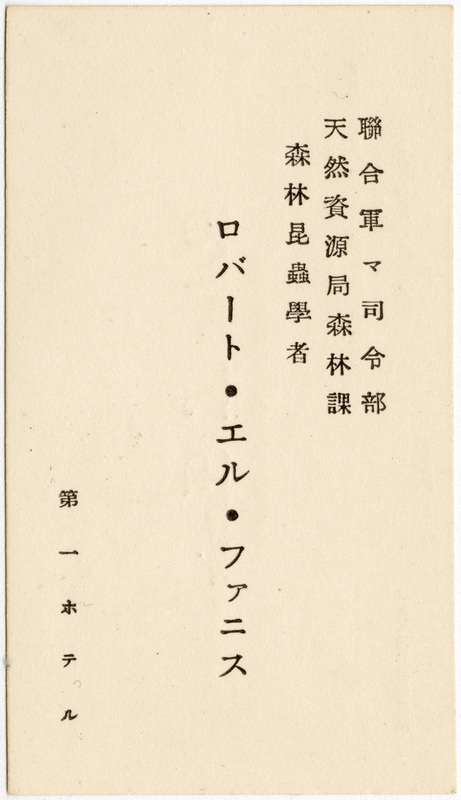
The accounts of Robert L. Furniss, forest entomologist
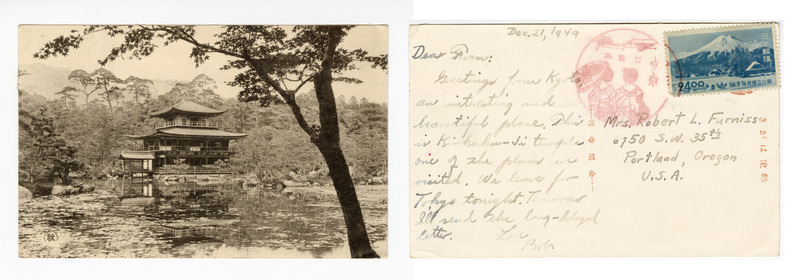
Much of Robert’s accounts can be found in letters written to his wife, Frances “Fran” Furniss. His letters highlight a world recovering from the tremendous traumas of war and reflect the resilience of humanity. Robert was assigned to Japan to aid in forest pest control, but his trips also served as a beautiful insight into human connection.
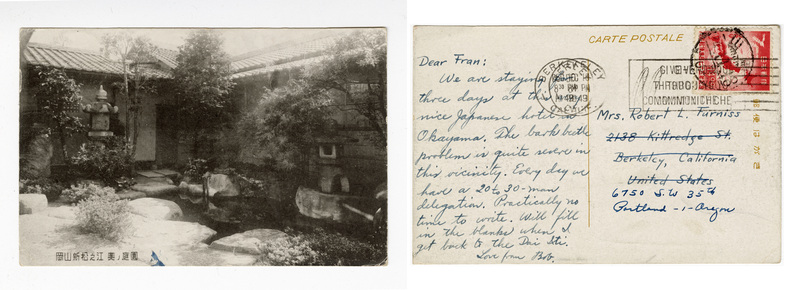
Robert arrived at Haneda airport, Tokyo on November 5th, 1949. He stayed at the Dai Iti Hotel as personnel for the Forestry Division of NRS. In his first letter to his wife Fran, after arriving in Japan, he wrote,
“It’s tomorrow here today and things are different…I haven’t seen enough yet to get much of an idea about the country, but I have a few impressions. Coming in over Tokyo Bay I was impressed by the tremendous expanse of dim lights making up Yokahama and Tokyo.”
In Robert’s letter, he seems to take his new environment in stride with curiosity and admiration. He wrote of his interactions with Japanese citizens with fondness. On November 13th, 1949, he wrote of his experience with a family in Usami while walking with his colleague Fred Shulley,
“As we walked along we noticed a little house just below the road and just above the sea. We stopped to admire a pretty little garden and the people immediately stuck their heads out to see what was going on. Shulley said “hello” and we were soon inside having tea. That was an experience I’ll not soon forget. They were the most hospitable people I have ever seen, bar none.”
While Robert wrote to Fran of his pleasant experiences with Japanese civilians and colleagues, several of his letters also hit on the devastation Japan was recovering from. In the same letter on November 13th Robert continued,
“Just what the family relationships were, I would be unable to say. The young man of the house, Tadashi Ito…his mother, a fine old lady with a great sense of humor and flare for telling a story; his wife, another young woman with a child, a young man, and an old man. The old man was not Tadashi’s father.
It developed that Tadashi had been an airplane pilot both before and during the war. He had been to mechanical school in Tokyo and spoke some English. During the war, he had been in the Philippines and apparently had been injured in Saigon. When the fire bombs came to Tokyo the family had to move out. They resettled to Ito.”
Robert’s observation on the Japanese populace became common theme in his letters to Fran. Often, he would touch on poverty, resource rationing, and the impact of bombing events in the country.
On November 9th, 1949, while shopping in the Meiji University district, Robert wrote,
“The street is lined with book stalls for several blocks. The stalls contain books from all over the world. Many are collector’s items. I am advised that the fires during the bombings destroyed many new books. Since paper is a critical item now, most of the books for sale are second hand.”
On November 11th, 1949 while traveling back from field work in Asakawa Robert observed:
“Every bit of the ride was vastly interesting and all very different. There’s no further need for me to read Voight’s works [presumably referencing ecologist William Vogt’s work on “apocalyptic environmentalism”] to understand the relationship between population pressure and the limitation of natural resources. On every hand the struggle for survival is going on and daily it is becoming more intense. No foot of ground is allowed to remain unproductive. The people work and work and work, and yet in the main they are a happy lot.”
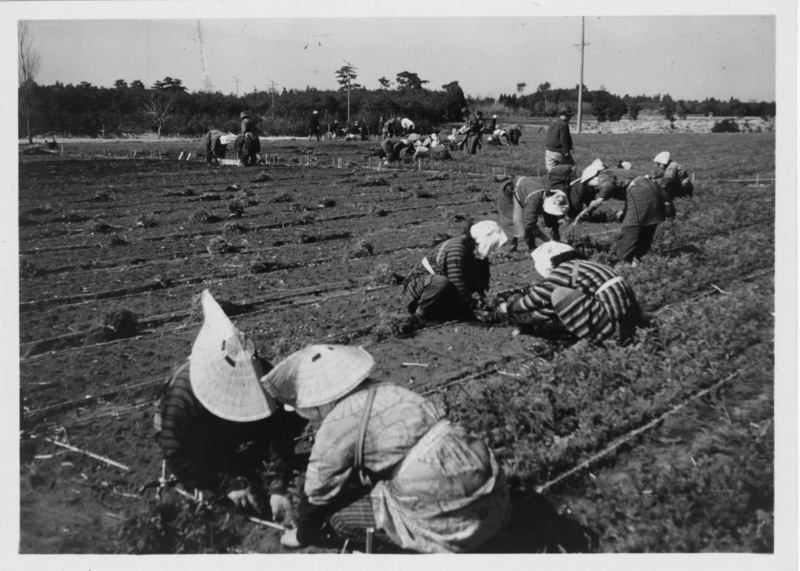
Robert writes several times about his surprise by the impact of the bombing events that devastated Japan. Writing on November 25th, 1949,
“I’m repeatedly amazed by the thoroughness of the bombing. It has been four years since the last bombs fell and yet the effects are present on all sides; there was hardly a city, town or village that escaped the bombing and practically everything went up in flames. It makes one wonder, especially here with the war still going on just across a narrow sea. It is quite evident that mankind is in mad pursuit of its own destruction. The means are at hand.” Just four years after the events, Robert would visit the atomic bombing sites of Hiroshima and Nagasaki.
On December 5, 1949, while visiting Hiroshima, he wrote, “It gives one an odd feeling to be where hell broke loose. It makes one wonder where the next outcropping will be. At 3:00PM we were in Hiroshima station–all new, as are all the houses anywhere near there. Shortly after leaving the station, we see the rounded dome framework of the well-known landmark that marks the center of the blasts.
Tom Suzaki, one of the interpreters with the expedition–his home is in Portland–was in Hiroshima shortly after the war ended. He said there were only a few people straying around then. (His aunt was one who was burned by the explosion.) Today, that was a stream of humanity pouring endlessly through the station gates. Things are normal in the city where 35,000 bodies were never found.”
On December 8, 1949, while visiting Nagasaki, Robert wrote, “On the way out in the morning we stopped and took some pictures of the point of impact for atomic bomb number 2. It was dropped a little off center, so only about half of Nagasaki was flattened. Some 30,000 people were killed including the student body of Nagasaki Medical School and a church full of Catholics. The Atomic Bomb Commission is still busy studying the effects. Visiting the point of impact helps one to realize what has been turned loose in the world.”
In his letters, he reflects on the long last effects of war on the country Japan. In many accounts, he discusses food rationing as well as the large class dispersity throughout the districts he visited. While Robert’s observations on the devastation were full of sorrow and contemplation, his accounts of his personal and very human interactions are found throughout his letters. Robert was fond of learning new cultural traditions from his Japanese colleagues and hosts, including parties. On November 20th, 1949 while attending a dinner in Tomo, Robert wrote,
“About 9PM we assembled in a Japanese room for dinner (a party). It seems that there is money set up in the forestry budget for the entertainment of visiting officials. Since food is severely rationed for the Japanese, the parties are quite popular and are well attended. The food served us was partly western and partly eastern. I tried everything except the raw fish, sea weed, and rice. That was where the beer drinking began. One gets dry without water and the Americans drink water only at approved places. So most of the time it’s beer or nothing. Have you ever tried to clean your teeth with beer?
…When the eating was over, the maids got out a portable phonograph (in place of a shamisen) and got under way. The demonstrated several Japanese dances, one of which I may be able to remember until I get back. They had several waltz and foxtrot records and insisted that Harold and I demonstrate Western-style dancing. There being no graceful way out, we complied. I’ll leave it to your imagination as the what kind of a demonstration that was, what with my aptitude for waltzing. Rather than prolong the agony, I thought it best to teach them the California Schottishe and Road to the Isles. They went over big even without any music. My regret was in not having a good square dance album. (Square dancing has hit the larger cities but only the rumors of it had reached Tomo). Anyway we had fun. The Mama-san was a dancing teacher and caught right on. The hotel owner’s wife (this family owns two big hotels in Tomo) also was an apt pupil. Before the evening was over they were all doing the schottishe, counting off the beat in Japanese. What a sight!”
The sharing of traditions such as dance and song were also a theme in Robert’s letter. While visiting the home of his Japanese colleague, Kato’s, uncle Robert wrote,
“It was at the home of his uncle, a physician and boy scout leader…When we arrived at the station about 2 hours later, the boy scout troop was out to greet us. We paraded about a mile through the main street of this town (population 45,000 and I forgot the name). Finally we arrive at the physician’s home, and there was a troop of girl scouts. That rounded the group out to about 60-70. Since that was too many to get in the house, there was great scurrying about the locate a hall and prepare it for the occassion. Finally all was in readiness and the show began. Afterward Fred lead the group in singing Japanese songs and Stephen Foster songs mixed about half-and-half. The kids really enjoyed it. It made one feel that that was the real way to get to the people.”
Robert’s assignment in Japan was not only necessary and impactful for the forest ecology and wood production of the country, but the relationship formed between scientists, citizens, and military officials would be essential for future global relationships.
Now, 81 years after the initial occupation of Japan, instead of adversaries, the United States and Japan are allies working toward a better future. The University of Idaho continues this by partnering with Hiroshima University, chartered in 1949, to offer new and enriching experiences through the Microchip Engineering and Security Alliance (MESA). Announced in May 2026, the MESA program seeks to aid in the growing demand for engineers in semiconductor industries.
In a world of turmoil, humans will always continue to find connections. While Robert’s letters touch on the struggle and impact of war, they also shine light on the bonds strangers can make in a short amount of time. Robert saw this even as he witnessed the aftermath of mankind’s worst weaponry. On his visit to Asakawa on November 11th, 1949,
Robert wrote,
“We saw large trees and humanity” More information about Robert L. Furniss and Malcolm M. Furniss can be found in the Malcolm M. Furniss papers.
Resources:
Furniss, M., 2006. Reorganization of Forest Pest Control in Japan: An Account of Robert Livingston Furniss’ Socio-Entomological Experiences During Assignments in 1949 and 1950. American Entomologist, 52(2), pp.76-83.
Letters from Robert to Frances (wife)